
The long-term vision
The Kind Kulture Institute.
A permanent home in Los Angeles for survivor testimony, art and human dignity, rooted in the legacy of the 1994 Genocide Against the Tutsi and dedicated to the full breadth of human memory.
The vision
A home for every story. Built one city at a time.
The Institute is being built in public, one exhibition and one city at a time. It begins with Stories in Color: A Human Dignity Exhibition, and the exhibition’s last stop will be the Institute’s opening night.
Why it must exist
History has museums. Knowledge has libraries. Justice has courthouses. Humanity deserves a home.
A permanent place where stories become teachers and strangers become neighbors.
Why now
Spaces for healing matter more than ever.
We have never been more connected, or more alone. People need places to slow down, listen, and talk with one another.

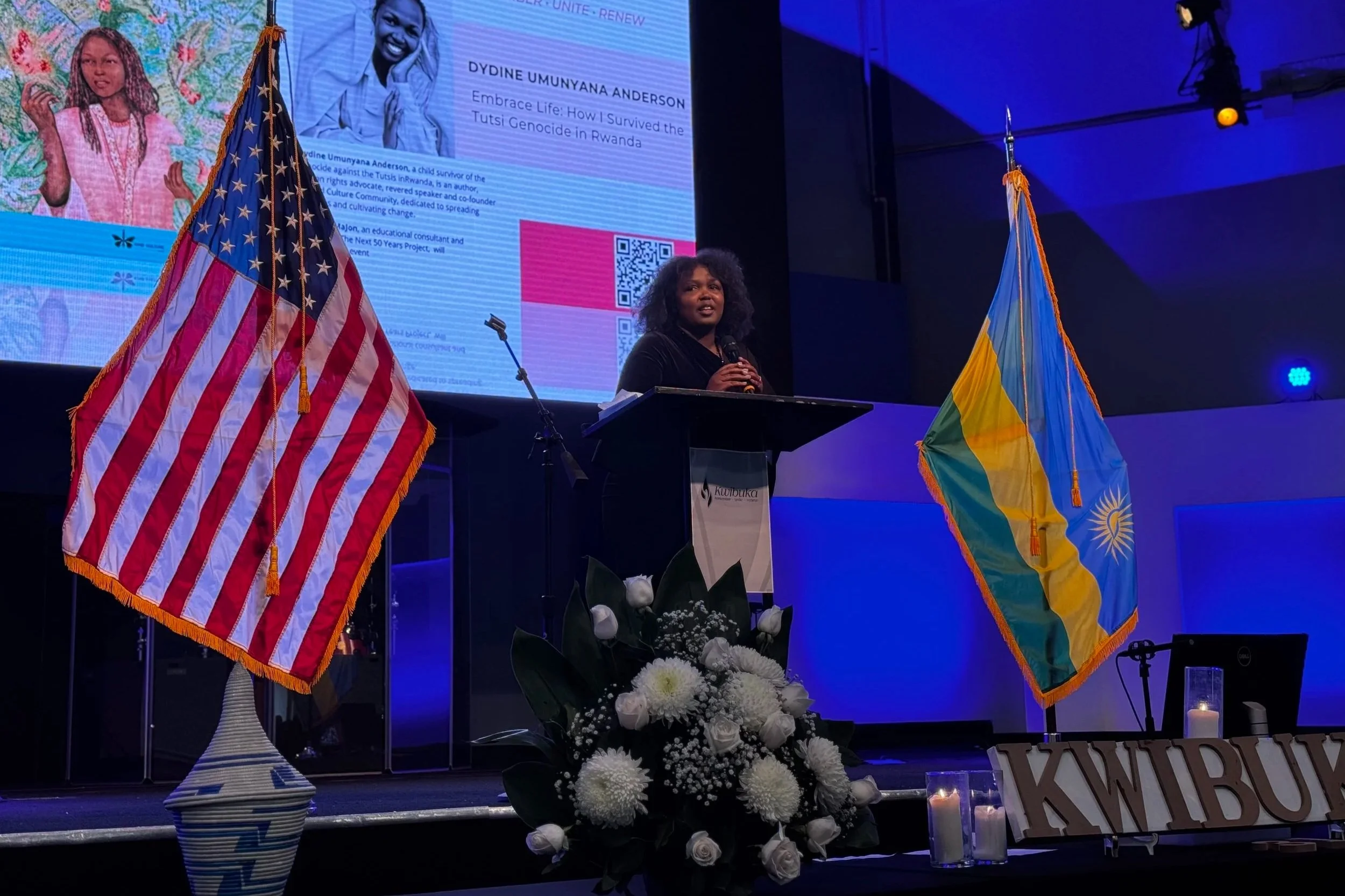
The work begins in rooms like this one, where the names are spoken and not forgotten.
Why Los Angeles
A city of ten million, at the intersection.
The Institute will stand in Los Angeles, at the intersection of culture, diaspora, education and global storytelling.
Diaspora
Many homes, one city.
Every community that has carried memory across borders lives here. The Institute belongs in a city where many diasporas already live.
Storytelling industry
Where stories travel from.
Hollywood, documentary filmmakers and media institutions at scale. A story told here travels.
Academic ecosystem
The university partners.
USC, UCLA, Cal State LA, Occidental. The classrooms and lecture halls the Institute will work alongside.
Philanthropic community
Mission-aligned funders.
Los Angeles foundations who share this work.
What the Institute holds
Four pillars, one institution.
Testimony archive
The record.
Thousands of hours of recorded testimony: video, audio, written. Open to researchers, educators, journalists, and to you.
Public programming
The rooms.
Survivor events, remembrance gatherings, youth engagement, community dialogues and civic programming.
Art and exhibitions
The collection.
Stories in Color as the permanent collection. Rotating commissioned works from global artists.
Education
The partnerships.
Partnerships with schools, universities, museums and human rights organizations.
Imagine your visit
A place you don’t simply visit.
Every space is shaped by one idea: Mirror · Bridge · Change.
- Walk through the Institute.
- Hear the voice of a survivor.
- Pause before a single photograph.
- Read a child’s journal.
- Sit in silence.
- Join a conversation with strangers.
- Leave carrying someone else’s story alongside your own.
The arc
Three phases to permanence.
Help us build it
Before there is a building to point to.
An institution is built by the people who choose to believe in it first. Founding Partners stay part of its record for life.
Kind Kulture is a registered 501(c)(3) nonprofit organization. EIN 85-0780571. Contributions are tax-deductible to the extent allowed by law.